







Hidden SaaS Costs Companies Ignore
Software-as-a-Service (SaaS) transformed the way businesses operate. Instead of investing heavily in servers, infrastructure, and in-house systems, companies can now launch operations quickly using subscription-based platforms.
At first glance, SaaS looks cost-effective. A small monthly subscription feels manageable, especially for startups and growing businesses. But as companies scale, many begin to realize a painful truth:
The real expense is not the subscription itself.
It’s the hidden operational burden behind it.
From rising subscription software expenses to workflow inefficiencies, integration complexity, and business process fragmentation, SaaS ecosystems can quietly become expensive and difficult to manage.
In 2026, businesses are spending more on SaaS than ever before. According to industry reports from Gartner and Zylo, organizations now use an average of 110+ SaaS applications across departments, while nearly 30% of SaaS spending is wasted on underutilized or duplicate software.
The result?
- Higher operational costs
- Reduced productivity
- Complex workflows
- Security concerns
- Scalability challenges
Understanding these hidden SaaS costs is critical for businesses that want sustainable growth without operational chaos.
Why SaaS Tools Seem Affordable at First?
SaaS became popular because it solved a major problem: accessibility. Instead of waiting months to deploy enterprise software, businesses could simply subscribe and start using tools immediately.
Low Upfront Costs Make SaaS Attractive:
Traditional software required:
- expensive hardware
- internal IT teams
- licensing fees
- maintenance infrastructure
SaaS eliminated much of that.
A CRM tool might cost only $25–$50 per user monthly. Project management software may appear affordable at first, while marketing, HR, accounting, and communication platforms all offer low entry pricing.
This creates the perception that SaaS software costs are minimal.
But small recurring costs across multiple departments eventually compound into significant annual expenses.
Fast Deployment Helps Businesses Scale Quickly:
SaaS tools allow companies to:
- onboard teams rapidly
- automate workflows
- collaborate remotely
- launch operations faster
For startups and SMEs, this flexibility is incredibly valuable.
According to Statista, global SaaS spending surpassed $300 billion in 2026, largely because businesses prioritize speed and operational flexibility.
However, growth introduces a new challenge.
The more a company scales, the more software it adopts.
And that’s where hidden technology costs begin to appear.
Also Read: Is it Better to Move from SaaS to Custom Software?
The Hidden SaaS Costs Most Companies Overlook:
Many businesses calculate monthly subscriptions but ignore the operational costs attached to managing an expanding SaaS ecosystem. These overlooked expenses slowly reduce efficiency and profitability.
Subscription Costs Add Up Faster Than Expected:
One SaaS platform rarely handles everything.
Businesses often subscribe to:
- CRM software
- marketing platforms
- communication tools
- HR systems
- analytics software
- project management apps
- automation platforms
- cybersecurity tools
Individually, they may seem affordable.
Combined, they become expensive.
Example:
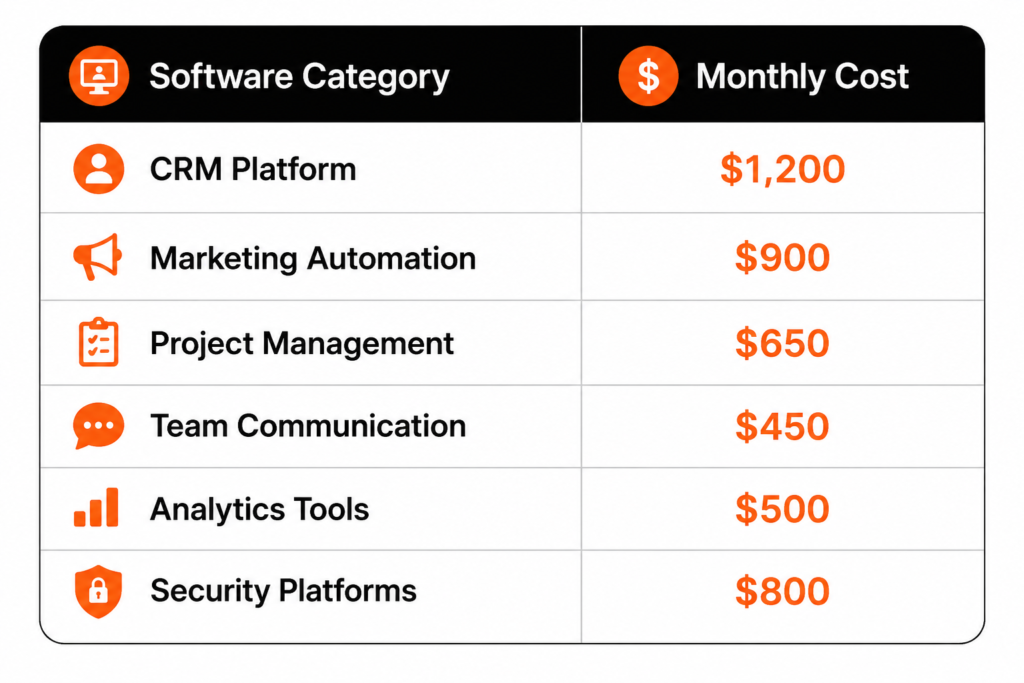
A mid-sized business can easily spend $50,000–$250,000 annually on SaaS subscriptions alone. These are the hidden SaaS costs many organizations underestimate.
SaaS Integration Costs Increase Over Time:
Modern businesses depend on connected systems. Unfortunately, most SaaS tools are not designed to work seamlessly together.
This creates additional SaaS integration costs, including:
- API development
- middleware subscriptions
- automation tools
- technical maintenance
- third-party connectors
Businesses often purchase automation software simply to make their existing software communicate properly.
Ironically, companies end up paying more software subscriptions to manage other subscriptions.
According to MuleSoft’s 2026 Connectivity Benchmark Report, enterprises now use an average of 1,200+ applications across systems, yet only around 29% are fully integrated.
Disconnected systems create:
- duplicate work
- delayed reporting
- operational bottlenecks
- inconsistent customer experiences
Productivity Loss from Switching Between Tools:
One of the most ignored hidden SaaS costs is lost productivity.
Employees constantly switch between:
- Slack
- Teams
- CRM dashboards
- spreadsheets
- analytics platforms
- email systems
- project management tools
Research from Harvard Business Review suggests employees can lose several hours weekly due to context switching and fragmented workflows.
This directly impacts:
- focus
- collaboration
- response times
- decision-making
The issue becomes worse when teams use different tools that don’t communicate efficiently.
This is a major example of business process fragmentation.
Employee Training and Onboarding Costs:
Every new SaaS platform introduces a learning curve.
Businesses spend money on:
- employee training
- onboarding sessions
- documentation
- certifications
- software adoption management
When companies use too many platforms, employees struggle to become fully efficient across systems.
New hires also require longer onboarding periods.
Over time, these subscription software expenses extend beyond software pricing itself.
Security and Compliance Costs Continue Growing:
Security is another major area businesses underestimate.
Every SaaS platform introduces:
- access control requirements
- data privacy concerns
- compliance risks
- user management complexity
More tools mean:
- more login credentials
- more security monitoring
- higher breach risks
- increased compliance responsibilities
IBM’s 2026 Cost of a Data Breach Report estimates the global average data breach cost now exceeds $5 million for many organizations. Businesses using fragmented SaaS environments often face higher security exposure because data exists across multiple disconnected systems.
Vendor Lock-In Creates Long-Term Risks:
SaaS platforms are designed to retain customers long term.
Migrating data away from a platform can become:
- technically difficult
- expensive
- time-consuming
Many businesses remain locked into systems simply because migration feels overwhelming.
As vendors raise prices or change policies, companies lose flexibility.
These SaaS hidden fees rarely appear during the initial purchase decision.
How Multiple SaaS Tools Create Operational Complexity?
The more software businesses adopt, the harder operations become to manage efficiently.
Disconnected Workflows Slow Teams Down:
Different departments often choose different platforms independently.
Marketing may use one CRM.
Sales uses another.
Operations relies on spreadsheets.
Customer service uses separate ticketing software.
The result?
Disconnected communication and workflow inefficiencies.
Multiple SaaS tools management becomes increasingly difficult as organizations grow.
Reporting and Analytics Become Inconsistent:
When data exists across multiple systems:
- reporting becomes fragmented
- analytics become unreliable
- leadership loses visibility
Businesses spend significant time manually consolidating reports from different platforms.
Instead of enabling efficiency, software complexity starts slowing growth.
Also Read: When Does Custom Software Make More Sense Than SaaS Products?
SaaS Scalability Issues Affect Growth:
SaaS works well initially.
But scaling creates challenges:
- higher user costs
- feature limitations
- integration complexity
- workflow restrictions
Many businesses eventually discover their tools cannot fully support operational growth.
These SaaS scalability issues often force organizations to reconsider their technology strategy entirely.
SaaS Automation Limitations Businesses Face:
Automation is one of SaaS’s biggest selling points. But most SaaS automation limitations appear when workflows become more complex.
Pre-built automations usually support:
- simple tasks
- standard workflows
- limited customization
Growing businesses often need:
- advanced approvals
- custom reporting
- unique customer journeys
- department-specific workflows
- centralized operational control
Most SaaS platforms struggle to support highly customized operations efficiently.
This forces businesses into manual workarounds that reduce productivity.
SaaS vs Custom Software: Long-Term Cost Comparison:
SaaS is not inherently bad.
For many startups, it’s the right starting point.
But long-term growth changes the equation.
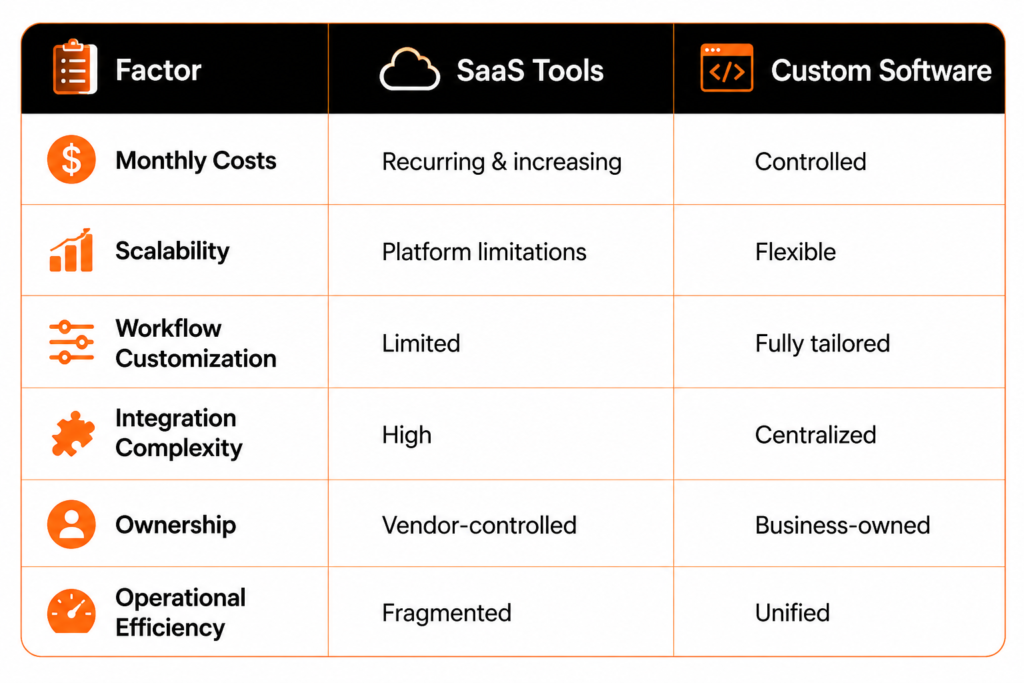
Businesses with:
- complex workflows
- scaling teams
- heavy automation needs
- security requirements
often benefit more from centralized custom systems over time.
Signs Your Business Is Overspending on SaaS:
Many companies don’t realize they have a SaaS problem until inefficiencies become severe.
Here are common warning signs:
Your Teams Use Too Many Platforms:
Employees constantly jump between systems to complete basic tasks.
Software Costs Increase Every Quarter:
Subscription renewals and per-user pricing continue rising.
Your Processes Still Require Manual Work:
Despite multiple tools, operations remain inefficient.
Reporting Takes Too Long:
Teams manually consolidate data from different systems.
Employees Avoid Certain Platforms:
Complicated systems reduce adoption and productivity.
How Businesses Can Reduce Hidden SaaS Costs:
Reducing SaaS expenses starts with visibility and strategic planning.
Audit Your SaaS Stack:
Identify:
- duplicate software
- unused subscriptions
- overlapping features
Remove Redundant Platforms:
Consolidating systems reduces operational complexity.
Automate More Efficiently:
Instead of relying on disconnected automations, businesses should centralize workflows where possible.
Improve Workflow Integration:
Better integration reduces:
- duplicate work
- reporting delays
- communication gaps
Consider Long-Term Scalability:
Businesses should evaluate technology decisions based on operational efficiency, not just short-term affordability.
Why Businesses Are Moving Toward Unified Software Ecosystems?
In 2026, businesses increasingly prioritize:
- centralized operations
- AI-driven automation
- unified dashboards
- scalable architecture
- connected workflows
Companies want technology ecosystems that improve efficiency rather than create operational friction.
This is why many organizations are shifting away from fragmented SaaS environments toward more integrated software strategies.
Final Thoughts:
SaaS tools revolutionized modern business operations. They provide speed, flexibility, and accessibility that traditional software often lacked. But as businesses scale, hidden SaaS costs become impossible to ignore.
From SaaS hidden fees and integration expenses to workflow inefficiencies and business process fragmentation, operational complexity can quietly reduce productivity and profitability.
The goal isn’t to eliminate SaaS completely.
It’s to build a technology ecosystem that supports long-term growth efficiently. Businesses that evaluate software strategically instead of simply adding more subscriptions position themselves for better scalability, stronger operational control, and sustainable growth.
If your organization is struggling with disconnected systems, rising software costs, or operational inefficiencies, Marsmatics can help businesses modernize workflows, develop scalable software solutions, and reduce technology complexity through custom development and intelligent automation.
FAQs
What are hidden SaaS costs?
Hidden SaaS costs include integration expenses, training costs, workflow inefficiencies, rising subscription fees, security management, and operational complexity caused by multiple disconnected platforms.
Why do SaaS software costs increase over time?
As businesses grow, they usually add more users, integrations, storage, automation tools, and additional platforms, which significantly increases total SaaS spending.
What are common SaaS scalability issues?
Common SaaS scalability issues include rising per-user costs, limited customization, integration complexity, fragmented workflows, and operational inefficiencies as businesses expand.
How can businesses reduce subscription software expenses?
Businesses can reduce subscription software expenses by auditing their SaaS stack, removing redundant tools, improving workflow integration, automating processes efficiently, and investing in scalable software strategies.