







AI Automation Without Strategy Is a Liability
Artificial Intelligence is transforming how businesses operate. From customer service chatbots to automated reporting and predictive analytics, AI promises greater efficiency, lower costs, and faster decision-making. It’s no surprise that organizations of all sizes are racing to adopt AI-powered solutions.
But there is a problem.
Many businesses are implementing AI without a clear plan. They invest in tools before understanding their processes, data, goals, or long-term requirements.
The result?
Expensive software subscriptions, poor user adoption, inaccurate outputs, and automation projects that fail to deliver meaningful results. The reality is simple: AI without strategy can become a liability instead of an asset.
This is why every successful AI initiative starts with a strong AI automation strategy.
Why AI Automation Is Growing So Quickly?
AI adoption has accelerated dramatically over the past few years.
According to McKinsey’s global AI research, more than 70% of organizations have adopted AI in at least one business function. Meanwhile, Gartner predicts that AI-powered automation will continue reshaping operations across customer service, marketing, finance, and supply chain management.
Businesses are investing because AI can help:
- Reduce repetitive manual work
- Improve productivity
- Enhance customer experiences
- Generate data-driven insights
- Increase operational efficiency
However, technology alone does not guarantee success.
Without a structured implementation plan, AI often amplifies existing business problems rather than solving them.
What Is an AI Automation Strategy?
An AI automation strategy is a structured roadmap that aligns AI initiatives with business objectives.
Instead of deploying tools simply because they’re available, businesses identify where automation can create measurable value and how success will be tracked.
A well-designed strategy typically includes:
- Business goals and KPIs
- Process evaluation
- Data readiness assessment
- Technology selection
- Governance policies
- Performance monitoring
Think of it this way:
Buying an AI tool without a strategy is like purchasing construction equipment before creating architectural plans.
The tools may be powerful, but without direction, results are unpredictable.
The Hidden Risks of AI Automation Without Strategy:
Many organizations assume AI will automatically improve operations.
In reality, poor planning creates significant risks.
Automating Broken Processes:
One of the most common mistakes is automating inefficient workflows.
If a process is already flawed, AI simply performs those flaws faster.
For example:
- Poor customer service processes become faster poor customer service.
- Inaccurate reporting systems generate inaccurate reports more quickly.
- Inefficient workflows become automated inefficiencies.
Before implementing automation, businesses must first optimize their processes.
Increased Operational Costs:
Many organizations purchase multiple AI tools across departments without coordination.
This often leads to:
- Duplicate software subscriptions
- Integration challenges
- Training expenses
- Low adoption rates
Instead of reducing costs, AI can create additional operational expenses.
Poor Data Quality
AI systems depend on data.
When data is inaccurate, incomplete, or inconsistent, AI outputs become unreliable. Industry experts often summarize this challenge with a simple phrase:
“Garbage in, garbage out.”
Without proper data governance, even advanced AI models struggle to deliver meaningful results.
4. Security and Compliance Risks:
Businesses handling customer information, financial records, or sensitive operational data must carefully evaluate how AI systems access and process information.
Potential risks include:
- Data breaches
- Unauthorized access
- Regulatory violations
- Intellectual property concerns
This is why governance should always be part of an AI implementation plan.
5. Loss of Customer Trust:
Customers expect accurate information and positive experiences.
Poorly implemented AI systems can result in:
- Incorrect chatbot responses
- Delayed resolutions
- Inconsistent communication
- Frustrating user experiences
Trust takes years to build and only moments to lose.
Signs Your Business Needs a Better AI Strategy:
Not sure whether your organization is moving too quickly?
Here are several warning signs:
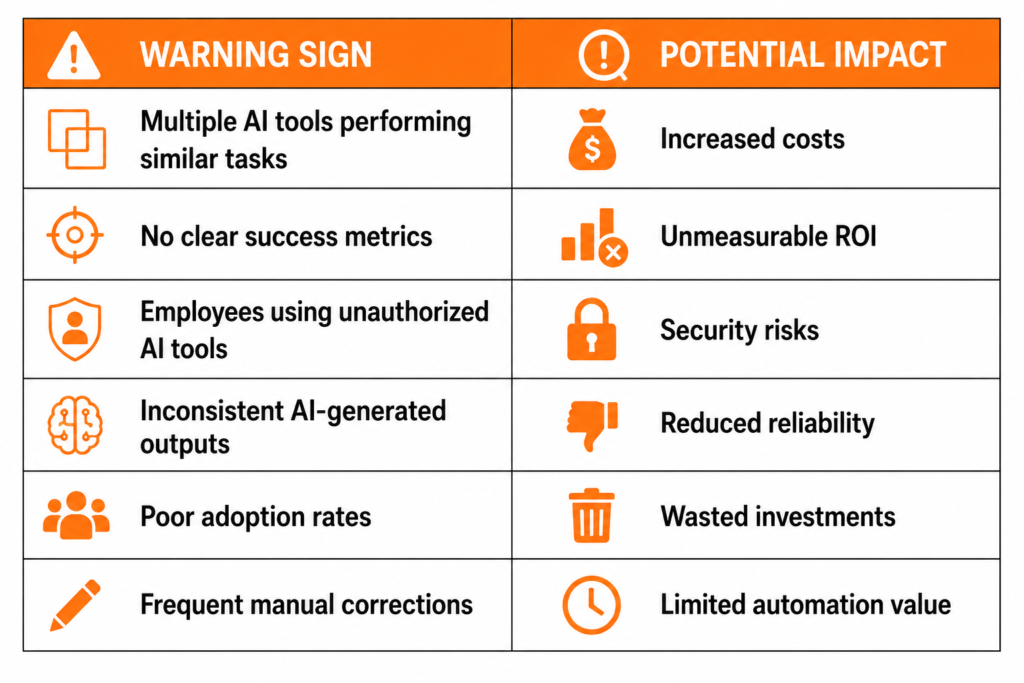
If your organization experiences several of these challenges, it’s time to revisit your AI roadmap.
An AI Automation Implementation Guide for Business Success:
A successful AI project doesn’t start with software.
It starts with strategy.
Step 1: Define Business Objectives:
Ask:
- What problem are we solving?
- What outcome are we trying to achieve?
- How will we measure success?
Clear goals provide direction and accountability.
Examples include:
- Reducing customer response times by 50%
- Automating repetitive reporting tasks
- Increasing lead conversion rates
Step 2: Evaluate Existing Processes:
Not every process should be automated.
Identify:
- Repetitive tasks
- Bottlenecks
- Manual workflows
- High-volume activities
These areas often provide the greatest return on investment.
Step 3: Assess Data Readiness:
Successful AI depends on quality data.
Review:
- Data accuracy
- Accessibility
- Consistency
- Security
Strong data foundations improve AI performance and reliability.
Step 4: Start Small:
Many organizations try to automate everything at once.
Instead, begin with a high-impact project.
Examples include:
- Customer support automation
- Automated reporting
- Lead qualification
- Inventory forecasting
Quick wins build confidence and create momentum.
Step 5: Measure and Optimize:
AI systems require ongoing monitoring.
Track:
- Productivity improvements
- Cost savings
- Customer satisfaction
- Operational efficiency
- ROI
Continuous optimization helps maximize long-term value.
Also Read: AI Co-Pilot Myths
AI Automation Best Practices Every Business Should Follow:
Successful organizations often follow similar principles when implementing AI.
Focus on Business Outcomes:
Technology should support business objectives, not become the objective itself.
Prioritize Data Quality:
Reliable data produces reliable results.
Keep Humans In The Loop:
AI should enhance human decision-making, not completely replace it.
Create Governance Policies:
Establish guidelines for:
- Data usage
- Security controls
- Compliance requirements
- AI accountability
Continuously Evaluate Performance:
The most successful businesses treat AI as an evolving capability rather than a one-time project. These AI automation best practices help reduce risk while improving long-term success.
AI Automation Strategy for Small Businesses:
Many small business owners believe AI is only for large enterprises.
That’s no longer true.
Today’s tools make automation accessible to organizations of all sizes.
An effective AI automation strategy for small businesses focuses on solving practical problems instead of pursuing complex enterprise-scale initiatives.
Good starting points include:
- Customer support automation
- Appointment scheduling
- Email marketing automation
- Sales follow-up workflows
- Reporting and analytics
Small businesses often achieve significant efficiency gains by automating just a few critical processes.
Ready to Build AI That Delivers Real Results?
Marsmatics helps businesses design and implement intelligent automation solutions that align with real business goals. Whether you’re exploring automation opportunities or developing a fully integrated custom AI automation solution, our team can help you build a smarter, scalable future with confidence.
Why Custom AI Automation Delivers Better Results?
Off-the-shelf tools can be useful.
However, they often struggle to address unique business requirements. This is where Custom AI automation becomes valuable.
Custom solutions are designed around your:
- Existing workflows
- Internal systems
- Data sources
- Business goals
Benefits of Custom AI Automation:
| Advantage | Benefit |
| Tailored Workflows | Matches business processes |
| Better Integration | Connects existing systems |
| Improved Security | Greater data control |
| Scalability | Supports future growth |
| Higher ROI | Eliminates unnecessary features |
For organizations seeking long-term competitive advantages, customized solutions often outperform generic platforms.
The Future Belongs to Strategic AI Adopters:
AI is no longer a future trend.
It is a present-day business reality. The companies that gain the most value from AI won’t necessarily be the ones using the most tools.
They’ll be the ones using AI with purpose. A thoughtful AI automation strategy helps businesses reduce risk, improve efficiency, enhance customer experiences, and generate measurable returns. Without strategy, automation becomes another expense. With strategy, it becomes a powerful growth engine.
Ready to Build AI That Delivers Real Results?
Marsmatics helps businesses design and implement intelligent automation solutions that align with real business goals. Whether you’re exploring automation opportunities or developing a fully integrated custom AI automation solution, our team can help you build a smarter, scalable future with confidence.
Final Thoughts:
AI has the potential to transform nearly every aspect of a business. But successful implementation requires more than technology.
It requires planning, process optimization, governance, and clear business objectives. Following a structured AI automation implementation guide, leveraging proven AI automation best practices, and investing in the right solutions can help organizations unlock the true value of automation while avoiding costly mistakes.