





Best Backend for Mobile App Development
75% of app development projects fail due to poor backend architecture decisions.
And the truth is most of these failures aren’t because of bad ideas… they happen because the foundation wasn’t built right.
Your backend controls how your app performs, scales, and handles real users. A slow, unstable, or poorly structured backend doesn’t just hurt performance it costs you users, revenue, and growth opportunities.
Whether you’re building a startup MVP or a full-scale mobile platform, choosing the right backend for mobile app development is one of the most important decisions you’ll make.
In this guide, we’ll break it down in simple terms so you can choose a backend that supports your app today and scales with you tomorrow.
In this guide, you’ll learn:
- What a mobile app backend actually is
- The best backend technologies in 2026
- How to choose the right one for your app
- Common mistakes to avoid
Let’s simplify it so you can make the right decision the first time.
What is a Mobile App Backend?
A mobile app backend is the engine behind your app.
It handles everything users don’t see but experience every time they use your app.
Key Components of a Mobile Backend:
- Server/Infrastructure → Where your app runs
- Database → Stores user data, content, transactions
- APIs (REST/GraphQL) → Connect frontend to backend
- Authentication Systems → Logins, permissions, security
- Business Logic → The “rules” of how your app works
In simple terms:
👉 The backend makes your app functional, secure, and scalable.
Without a strong backend, even the best-designed app will fail.
Also Read: Low-Code & No-Code Mobile App Development
Top Backend Technologies for Mobile Apps (2026)
Let’s break down the best backend technologies for mobile apps based on real use cases.
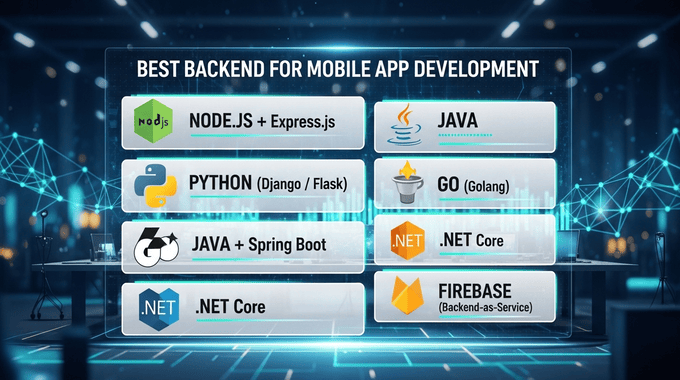
Node.js + Express.js
Best for: Real-time apps, startups, MVPs
Node.js is one of the most popular backend technologies because it’s fast, flexible, and uses JavaScript.
Why developers choose it:
- Non-blocking architecture → Handles multiple users easily
- Fast development → Same language for frontend + backend
- Huge ecosystem
Use case:
Perfect for apps like chat platforms, food delivery, or e-commerce with real-time updates.
Python (Django / Flask)
Best for: Data-heavy apps, AI-powered apps
Python is known for simplicity and speed of development.
Strengths:
- Clean, readable code
- Great for AI/ML integration
- Rapid prototyping
Use case:
Healthcare apps, analytics platforms, or AI-based mobile solutions.
Java + Spring Boot
Best for: Enterprise-grade applications
Java is reliable, scalable, and widely used in industries like finance.
Why it stands out:
- Strong performance
- High security
- Mature ecosystem
Use case:
Banking apps, fintech platforms, or large-scale systems with millions of users.
Go (Golang)
Best for: High-performance, scalable apps
Go is built for speed and efficiency.
Advantages:
- Lightweight and fast
- Handles concurrency extremely well
- Ideal for microservices
Use case:
Apps that need high performance and low latency.
.NET Core
Best for: Enterprise + Microsoft ecosystem
Key benefits:
- Strong tooling
- Secure architecture
- Great for enterprise integrations
Use case:
Corporate apps or systems integrated with Microsoft services.
Firebase (Backend-as-a-Service)
Best for: Startups, MVPs, non-technical teams
Firebase removes the need to manage servers.
Why it’s popular:
- Fast setup
- Real-time database
- Built-in authentication
Limitation:
Vendor lock-in and rising costs at scale.
Use case:
Quick MVP launches or early-stage apps.
Backend Architecture Patterns for Mobile Apps
Choosing a backend isn’t just about technology it’s about architecture.
Monolithic Architecture
- Simple and easy to build
- Best for small to medium apps
Microservices Architecture
- Breaks app into smaller services
- Highly scalable
- More complex to manage
Serverless Architecture
- No server management
- Pay only for usage
- Great for variable workloads
API-First Approach
- Build APIs before frontend
- Enables flexibility across platforms
- Supports REST or GraphQL
👉 Modern apps often combine these approaches.
Database Selection for Mobile Apps
Your database choice affects performance, scalability, and flexibility.
SQL Databases (Structured Data)
- PostgreSQL
- MySQL
Best for:
Apps with complex queries and structured data
NoSQL Databases (Flexible Data)
- MongoDB
- Firebase Realtime DB
- DynamoDB
Best for:
Real-time apps, fast scaling, flexible schemas
Hybrid Approach
Many apps use both SQL + NoSQL for better performance.
Security Considerations for Mobile Backends
Security is not optional it’s critical.
Key Security Layers
- Authentication: OAuth, JWT
- Encryption: SSL/TLS, data encryption
- API Security: Rate limiting, access control
- Compliance: HIPAA, GDPR, PCI-DSS
👉 One weak layer can compromise your entire app.
Scalability & Performance Optimization
If your app grows, your backend must grow with it.
Key Strategies
- Load balancing
- Caching (Redis, Memcached)
- Database optimization
- CDN for faster delivery
- Monitoring tools
👉 A 1-second delay can reduce conversions by up to 20%.
Performance = revenue.
Cost Comparison of Backend Technologies
| Technology | Cost Level | Best For |
| Node.js | Low | Startups, real-time apps |
| Python | Low | Data-heavy apps |
| Firebase | Low → High | MVPs |
| Java | Medium-High | Enterprise |
| Go | Low | High-performance apps |
👉 The cheapest option upfront isn’t always cheapest long-term.
Also Read: Top Features Every Successful Mobile App Should Have
How to Choose the Right Backend
Here’s a simple framework:
Define Your App Needs
- Real-time or not?
- Expected users?
- Data complexity?
Evaluate Your Team
- Existing skills
- Hiring availability
Consider Scalability
- Will your app grow fast?
- Can your backend handle it?
Check Security Requirements
- Industry regulations
- Data sensitivity
Think Long-Term
- Maintenance
- Costs at scale
- Flexibility
Common Mistakes to Avoid
- Choosing tech just because it’s popular
- Ignoring scalability early
- Underestimating security
- Over-engineering from day one
- Not planning for growth
👉 Smart backend decisions save thousands later.
Future Trends in Mobile App Backends
What’s coming next?
- AI-powered backend optimization
- Edge computing for faster performance
- Serverless-first architecture
- Blockchain integration
- Real-time everything
👉 Backend is becoming smarter, faster, and more automated.
Conclusion
There is no single “best backend for mobile app development.”
The best backend is the one that fits:
- Your app requirements
- Your budget
- Your scalability goals
But one thing is clear:
👉 Your backend decision will define your app’s success.
Build the Right Backend From Day One
Choosing the right backend isn’t something you want to guess.
It requires experience, planning, and a deep understanding of how apps scale in the real world.
Marsmatics helps startups and enterprises design scalable, secure, and performance-driven mobile backends from MVP to full-scale deployment.
Whether you’re starting from scratch or improving an existing system:
👉 Work with Marsmatics to build a backend that actually supports your growth.
FAQs
What is the best backend for mobile app development?
The best backend depends on your app needs. Node.js is great for real-time apps, Python works well for data-heavy apps, and Firebase is ideal for MVPs. There is no one-size-fits-all solution.
Is Firebase good for mobile apps?
Yes, Firebase is excellent for startups and MVPs because it’s fast to set up and requires no backend management. However, it may become expensive and limiting as your app scales.
Which backend is best for scalability?
Technologies like Node.js, Go, and Java with microservices architecture are best for scalability. They allow apps to handle large user bases efficiently.
How do I choose the right backend for my app?
Start by defining your app requirements, scalability needs, budget, and team expertise. Then choose a backend that aligns with those factors rather than following trends.