







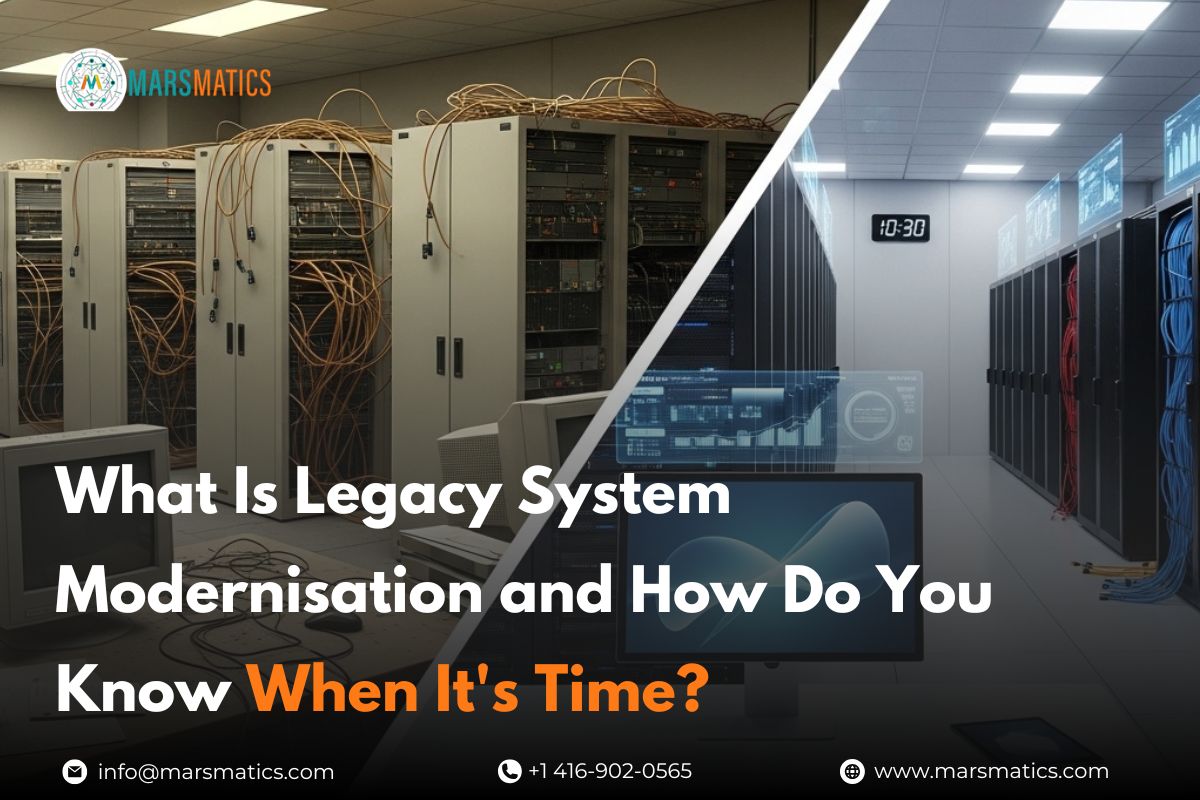
What Is Legacy System Modernization and How Do You Know When It’s Time?
Here’s a number that should stop any business leader in their tracks: organizations running legacy infrastructure spend, on average, 70% of their entire IT budget just keeping old systems alive. That leaves a mere 30% for innovation, growth, and everything that actually moves the business forward.
Think about that for a moment. You’re spending the majority of your technology investment maintaining the past not building the future.
If that sounds familiar, you’re not alone. In 2026, hundreds of thousands of businesses across every industry are trapped in the same cycle: patching systems that were never designed for today’s demands, losing developers who’d rather not touch decade-old codebases, and watching competitors pull ahead because their tech stack actually lets them move fast.
The question isn’t whether legacy system modernization is relevant to your business. The question is whether you’ve waited too long already.
This guide will walk you through exactly what legacy modernization means, the unmistakable warning signs that your systems are overdue for an upgrade, what the process actually involves, and how to take the first step without disrupting the business you’ve worked hard to build.
What Is Legacy System Modernization?
Legacy system modernization is the process of upgrading outdated business technology applications, databases, infrastructure, and processes into modern, scalable, and secure systems that meet today’s digital needs.
It doesn’t always mean rebuilding everything from scratch. Depending on the situation, it can include migrating systems to the cloud, re-architecting monolithic applications into microservices, improving database performance, or replacing unsupported legacy software.
When to modernize legacy systems often becomes clear when systems slow down business growth, create security risks, or struggle to integrate with modern tools.
In short, software modernization for enterprises is about aligning technology with business goals making systems more efficient, flexible, and future-ready instead of holding them back.
Legacy Modernization vs. Digital Transformation | What’s the Difference?
These two terms often get used interchangeably, but they’re not the same thing. Legacy system modernization is typically a component within a broader digital transformation strategy not the whole picture.
Digital transformation is the overarching ambition: rethinking how your business operates and delivers value in a digital world. Modernization is the foundational step that makes transformation possible. You can’t build AI-powered workflows, real-time customer experiences, or scalable cloud infrastructure on top of a system that was built in 2003 and last updated in 2011.
Put simply: digital transformation is where you want to go. Legacy modernization is what clears the road to get there.
Why Legacy Systems Are a Bigger Risk Than Most Businesses Realise?
Most business leaders know, somewhere in the back of their minds, that their older systems are a problem. What they underestimate is the scale of that problem and how fast it compounds.
The financial case for acting is striking. According to industry research, legacy maintenance costs run 3 to 5 times more annually than a modernized equivalent and that’s before factoring in the cost of a breach or unplanned downtime. Reducing IT maintenance costs isn’t just a line item on a spreadsheet; it’s one of the most direct paths to freeing up capital for genuine innovation.
The market is growing fast precisely because businesses are waking up to this reality. The global legacy modernization market was valued at $24.98 billion in 2025 and is projected to reach $56.87 billion by 2030 nearly doubling in five years. That growth isn’t hype. It’s businesses recognizing a problem they can no longer defer.
Beyond the financials, the risks are operational and existential:
- Security exposure increases every year a legacy system goes unpatched. Regulatory frameworks like DORA and Basel IV now demand real-time data access and auditability that most legacy environments simply cannot provide.
- Talent is walking out the door. Skilled engineers don’t want to work on systems built in outdated languages. As the developers who built and maintained those systems retire, institutional knowledge disappears with them.
- AI integration becomes impossible. Modern AI capabilities from real-time analytics to LLM-powered workflows require modern architecture to run on. Legacy systems don’t just slow AI adoption; they block it entirely.
The longer modernization is delayed, the more disruptive and expensive the eventual project becomes. The organizations winning in 2026 are the ones who treated this as a strategic priority two years ago. The organizations struggling are the ones waiting for a crisis to force their hand.
7 Warning Signs Your Business Needs Legacy System Modernization
The tricky thing about legacy systems is that their decline is gradual. The warning signs don’t arrive all at once they accumulate quietly until the cost of inaction outweighs the cost of change. Here are the seven signals that tell you the tipping point has been reached.
1. Your Maintenance Costs Are Eating Your Innovation Budget:
When your IT team spends the majority of its time and budget keeping existing systems running applying patches, fixing recurring bugs, managing infrastructure that requires constant attention there’s nothing left over to build new capabilities. This is the most common pattern in businesses that are falling behind their more agile competitors, and it’s one of the clearest signals that it’s time to modernize.
2. You Can’t Find Developers Who Know the System:
This one is more common than most business owners expect. Certain legacy systems were built on programming languages COBOL being the most well-known example that very few developers learn today. When your entire system depends on knowledge held by one or two people who are approaching retirement, you’re one resignation away from a serious operational crisis.
3. Integration With Modern Tools Is Broken or Impossible:
Does your system connect to your CRM? Your analytics platform? Your payment gateway? Modern businesses run on interconnected tools, and if your core system can’t talk to the rest of your stack via APIs, you’re either building expensive custom workarounds or simply going without capabilities your competitors take for granted.
4. Security Patches Are Delayed, Rare, or No Longer Available:
Legacy applications built on outdated frameworks carry an ever-growing vulnerability surface. Vendors eventually stop supporting older software versions meaning security updates stop arriving, and every day that passes is another day of unaddressed risk. This is where a proper legacy system risk assessment becomes non-negotiable: if you haven’t mapped your exposure, you genuinely don’t know how vulnerable you are.
5. Your System Can’t Scale With Demand:
Growth is supposed to be a good problem to have. But if every spike in traffic, users, or transaction volume causes your system to creak, slow, or fail, growth becomes a liability rather than an asset. A scalable software architecture one that can flex up or down based on real-time demand is a basic requirement for any business expecting to grow. Legacy monoliths simply weren’t designed with that flexibility in mind.
6. Releasing New Features Takes Weeks (or Months):
In a modern software environment, capable teams ship new features in days. If your development team is consistently telling you that a small change will take six weeks because of how tightly everything is coupled, that’s not a people problem it’s an architecture problem. Your system is slowing you down, and that lag has a direct cost in missed market opportunities.
7. You Can’t Integrate AI or Access Real-Time Data:
This is the defining challenge of 2026. Businesses everywhere are racing to embed AI into their products and operations from predictive analytics to intelligent automation. But modern AI capabilities require modern architecture. If your data pipelines can’t support real-time processing, or your codebase can’t integrate with AI APIs, you’re locked out of the most significant technological shift in a generation. This alone is accelerating the urgency of software modernization for enterprises across every sector.
Recognise three or more of these? The window for a smooth, phased transition is still open but it won’t be indefinitely.
Book a free legacy system assessment with our team
What Does Legacy System Modernization Actually Involve?
One of the biggest reasons businesses delay modernization is uncertainty about what the process actually looks like. The fear of a catastrophic, business-halting overhaul keeps many organizations stuck. The reality, when approached properly, is considerably less dramatic.
The 6 Core Modernization Strategies (The 6 Rs):
Modernization isn’t a single thing it’s a spectrum of approaches, each suited to different situations. The most widely used framework covers six strategies:
Rehost (Lift and Shift): Move your application to the cloud with minimal changes to the code itself. This is the fastest and lowest-risk starting point, and it immediately begins reducing infrastructure costs.
Replatform: Move to the cloud with targeted optimizations updating the runtime or database engine, for example without rearchitecting the application itself.
Refactor: Restructure existing code to improve performance, maintainability, and cloud-readiness, without fundamentally changing its external behaviour.
Rearchitect: Redesign the application’s structure typically breaking a monolith into microservices to unlock scalability and independent deployment.
Rebuild: Redevelop the application from scratch on a modern technology stack, preserving the business logic but discarding the old code entirely.
Replace: Retire the legacy system entirely and replace it with an off-the-shelf modern solution that meets the same business need.
The right approach depends on the age of your system, the complexity of your codebase, your timeline, and your budget. A competent modernization partner will recommend the right strategy not the most expensive one.
Also Read: Why Agile Teams Outperform Solo Freelancers in Software Development?
What Does a Cloud Migration Strategy Look Like?
For most organizations, cloud migration is the centrepiece of their modernization effort. A sound cloud migration strategy follows a phased structure: starting with a detailed assessment of existing systems and dependencies, identifying which workloads to migrate first (typically lower-risk, higher-impact ones), executing the migration in controlled stages, and validating performance and security at each step before proceeding.
The key word is phased. Responsible cloud migration doesn’t mean flipping a switch overnight. It means moving deliberately, with business continuity protected throughout.
Realistic Timelines and Costs:
No two projects are identical, but here are honest benchmarks:
- Small projects (single application, limited integrations): 2–4 months, typically starting from £15,000–£40,000
- Mid-sized projects (multiple systems, cloud migration, API integration): 6–12 months, £50,000–£150,000+
- Enterprise programmes (full re-architecture, regulatory compliance, multi-system): 12–24+ months, scoped individually
Costs vary based on the modernization strategy chosen, the size of the existing codebase, your technology stack, and the expertise of your partner. Any credible provider will scope your project thoroughly before committing to numbers treat vague upfront pricing as a red flag.
How to Modernize Without Disrupting Your Business:
This is the concern we hear most often and it’s a legitimate one. The solution isn’t to delay modernization; it’s to choose the right approach.
The most effective modernization projects in 2026 are incremental and phased, not big-bang replacements. Rather than attempting to replace everything at once, a well-structured programme runs old and new systems in parallel, migrating components progressively while the business continues to operate normally.
One proven technique is the Strangler Fig pattern: new functionality is built on the modern platform first, while legacy components are gradually replaced piece by piece much like a fig tree that slowly envelops and replaces the host tree it grows around. Over time, the legacy system is “strangled” by the new one, with zero moment of catastrophic cutover.
What you should expect from a responsible modernization partner:
- A thorough discovery and assessment phase before any code is written
- A phased delivery plan with clear milestones and risk controls
- Parallel running of old and new environments during transition
- Testing and validation at every stage before cutover
- A defined rollback plan if anything unexpected occurs
- Post-launch support and monitoring
Modernization done this way isn’t a leap of faith. It’s a managed, controlled process with built-in safety nets.
What Businesses Actually Gain?
The case for modernization isn’t just about avoiding risk it’s about the measurable upside on the other side.
Research from enterprise modernization programmes shows:
- 40–60% reduction in IT operational costs by eliminating expensive mainframe licensing, manual maintenance, and redundant infrastructure
- 30–50% faster feature delivery for teams working on modernized platforms compared to those constrained by monolithic systems
- 42% reduction in technical debt when AI-driven modernization approaches are used to systematically identify and address legacy code issues
- Teams that modernized their data pipelines have seen real-time payment adoption more than double between 2023 and 2026 a capability their legacy-bound competitors simply couldn’t match
One global banking institution that migrated its core platforms to a hybrid cloud environment cut system downtime by 70% while simultaneously enabling new digital product launches that would have been impossible on the previous infrastructure. A retail chain that shifted to an API-first architecture saw a 40% improvement in customer order accuracy within 12 months of modernization.
These aren’t edge cases. They’re consistent outcomes for organizations that approach modernization strategically, with the right partner, and with realistic expectations.
Also Check Out: When Should a Growing Business Move from SaaS to Custom Software?
How to Choose the Right Legacy System Modernization Partner?
Not all development companies offering legacy system modernization services are created equal. The wrong partner can turn a manageable project into a costly, disruptive ordeal. Here’s what separates the credible from the rest.
Proven methodology, not just tooling. A strong partner will have a defined process for assessment, strategy, execution, and post-launch support. If they jump straight to talking about technology without first understanding your business and your system, walk away.
Transparency on cost and timeline. Modernization projects can expand in scope if not properly managed. Look for partners who invest in thorough scoping upfront and who speak plainly about what drives cost not those who give you a suspiciously round number on the first call.
Experience with systems like yours. Industry-specific experience matters. A partner who has modernized financial services platforms understands compliance requirements, audit trails, and zero-tolerance for downtime. That expertise isn’t interchangeable.
Phased delivery and business continuity commitment. Ask directly: “How do you protect our operations during the transition?” If the answer is vague, that’s a warning sign.
Post-launch support. Modernization doesn’t end at go-live. The right partner stays involved through stabilization, optimization, and ongoing improvement.
The Bottom Line: Modernization Is No Longer Optional
Legacy system modernization has moved from a “nice to have” to a strategic imperative. The businesses that invested in their foundations two years ago are the ones deploying AI, scaling effortlessly, and outpacing their competitors today. The businesses that are still deferring are carrying a debt financial, operational, and competitive that only grows heavier with time.
The good news: modernization doesn’t have to be a disruption. With the right strategy, the right partner, and a phased approach that protects your operations throughout, it’s one of the most measurable, high-return investments a technology-dependent business can make.
Frequently Asked Questions
What’s the difference between legacy system modernization and a full system rebuild?
Legacy system modernization improves existing systems instead of replacing everything. It can include cloud migration strategy, refactoring, or upgrading parts of the system. A full rebuild replaces everything from scratch and is usually only needed when the system is no longer usable.
How much does legacy system modernization cost?
The cost of legacy system modernization depends on system size, complexity, and approach. Small projects may start from £15,000–£40,000, while larger software modernization for enterprises can range from £50,000–£150,000+. Enterprise-level solutions are usually custom-scoped after analysis.
How long does legacy system modernization take?
Timelines vary based on scope. Small to mid projects usually take 3–9 months, while large enterprise programs can take 12–24+ months. With a scalable software architecture, improvements can be delivered in phases so businesses see value early.
Can we keep running our business during modernization?
Yes. Modernization is usually done in phases, so your systems stay live. A strong cloud migration strategy ensures minimal disruption while upgrades happen in the background, keeping business operations stable throughout.