







Why Did My Software Project Go Over Budget? (And How to Prevent It Next Time)
Software projects rarely fail overnight. They fail quietly… one missed estimate, one extra feature, one delayed decision at a time.
If your software project went over budget, you’re not alone. In fact, studies show that over 50% of software projects experience cost overruns, and nearly 1 in 6 projects exceed their budget by 200% or more.
The real question is not what went wrong…
It’s why it happened and how you make sure it never happens again.
Why Do Software Projects Go Over Budget?
Software projects go over budget due to inaccurate estimation, unclear requirements, scope creep, and poor cost tracking. Hidden expenses, communication gaps, and unrealistic timelines further increase costs. Without structured planning and continuous monitoring, even small inefficiencies can turn into major software project cost overruns.
The Real Reasons Your Software Project Exceeded Budget:
Let’s break down the most common project budget overrun causes the ones that silently drain your resources.
Poor Software Development Cost Estimation:
It usually starts here.
Most teams underestimate:
- Development complexity
- Integration challenges
- Testing and debugging time
This leads to unrealistic budgets from day one.
Common project estimation mistakes include:
- Estimating based on assumptions, not data
- Ignoring edge cases and scalability
- Not accounting for post-launch fixes
Reality: A weak estimate doesn’t just affect planning it sets your entire project up for failure.
Also Read: How Much Does It Cost to Build a Mobile App in Canada & US?
Scope Creep (The Silent Budget Killer):
Scope creep is one of the biggest reasons why software projects fail budget expectations.
It happens when:
- New features are added mid-project
- Stakeholders request “small changes” repeatedly
- There’s no formal change approval process
Example (project scope creep example):
A simple e-commerce app starts with basic checkout… then adds subscriptions, loyalty programs, AI recommendations and suddenly the budget doubles.
Key Insight: Small changes feel harmless, but collectively they destroy budgets.
Lack of Clear Requirements:
When requirements are vague, everything becomes expensive.
- Developers guess what’s needed
- Rework becomes frequent
- Time and cost increase
Stat Insight: Poor requirement definition contributes to up to 30% of project failures globally.
Inefficient Project Management:
Without proper management:
- Deadlines slip
- Costs aren’t tracked
- Teams lose direction
This is where managing software project costs becomes nearly impossible.
Communication Gaps:
Miscommunication leads to:
- Incorrect features
- Rework cycles
- Delayed approvals
And every delay = more cost.
Hidden and Unexpected Costs
These are the costs nobody talks about upfront:
- Third-party APIs and integrations
- Cloud infrastructure scaling
- Licensing fees
- Maintenance and support
👉 Many teams underestimate these, leading to major software project cost overruns later.
Unrealistic Timelines
Trying to “rush” a project often backfires.
- Overtime increases costs
- Quality drops → more bugs
- Fixing errors becomes expensive
Truth: Faster doesn’t mean cheaper. It often means more expensive.
Cost Breakdown: Where Budgets Usually Go Wrong
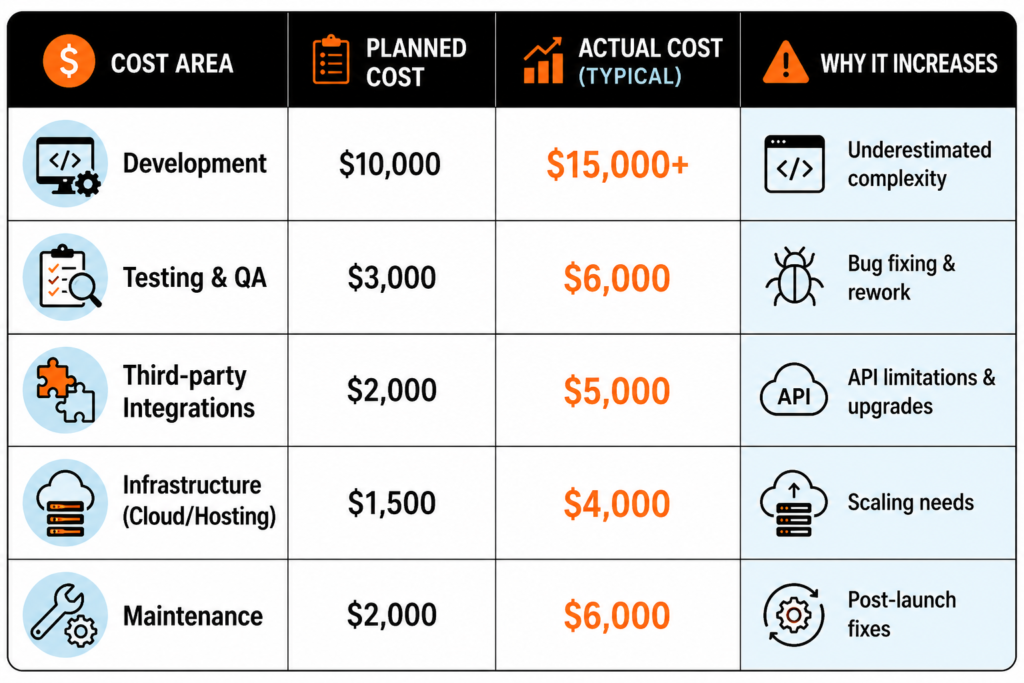
Insight: Most overruns don’t come from one big mistake they come from multiple small ones stacking up.
Also Read: Saas to custom software transition guide
How to Prevent Software Project Budget Overruns
Now let’s flip the script.
Here’s how you stay in control.
Start With Accurate Cost Estimation
- Break the project into smaller tasks
- Use historical data
- Include a 10–20% contingency buffer
👉 Smart software development cost estimation is your first line of defense.
Define Clear Scope and Requirements
- Document everything in detail
- Use wireframes and prototypes
- Get stakeholder approval before development
Clarity reduces confusion and saves money.
Implement Strong Change Management
Every change should answer:
- What’s the cost impact?
- What’s the timeline impact?
No approval = no change.
Use Agile for Better Cost Control
Agile helps you:
- Deliver in smaller phases
- Catch issues early
- Avoid large-scale failures
👉 This directly reduces software project cost overruns.
Monitor Budget in Real-Time
Use tools to:
- Track spending weekly
- Compare planned vs actual costs
- Adjust strategy early
Choose the Right Development Partner
This is where most businesses either save money… or lose it.
An experienced team:
- Plans better
- Executes efficiently
- Avoids costly mistakes
Before vs After: Controlled vs Uncontrolled Projects
| Factor | Poorly Managed Project | Well-Managed Project |
| Budget Accuracy | Low | High |
| Scope Control | Weak | Strong |
| Cost Visibility | Limited | Real-time tracking |
| Risk Management | Reactive | Proactive |
| Final Outcome | Over budget | On budget |
Key Takeaways
- If your software project went over budget, it’s not random it’s predictable
- Most project budget overrun causes start early in planning
- Control comes from systems, not luck
How Marsmatics Helps You Stay on Budget?
At the end of the day, success isn’t just about building software, it’s about building it right.
With Marsmatics, you get:
- Structured planning and accurate estimation
- Transparent pricing with no hidden surprises
- Agile execution with real-time cost tracking
- Scalable solutions designed to grow with your business
Planning your next software project? Work with Marsmatics to build smarter, reduce risks, and stay within budget without compromising quality.
FAQs
Why do most software projects exceed their budget?
Most projects exceed budgets due to poor estimation, unclear scope, and scope creep. Without proper planning and monitoring, costs quickly escalate.
How can I improve software development cost estimation?
Use data-driven estimates, break tasks into smaller components, and include buffer time and cost for unexpected challenges.
What are common project estimation mistakes?
Common mistakes include underestimating complexity, ignoring testing time, and failing to account for third-party dependencies.
How can I manage software project costs effectively?
Track costs regularly, control scope changes, use Agile methodologies, and work with experienced development teams.